
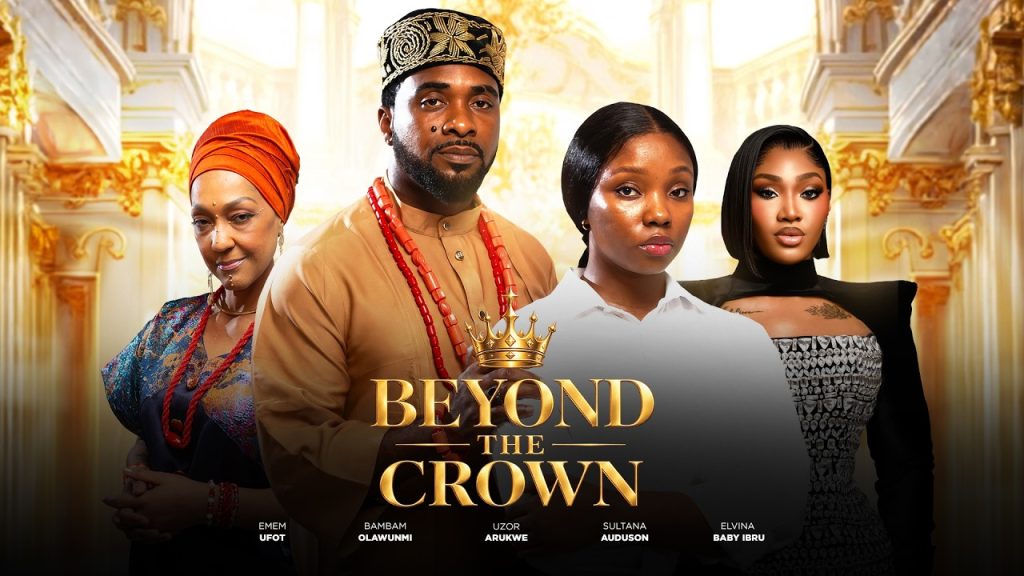
Sometimes, a movie comes along with a promising premise, a recognisable cast, and the potential to deliver a compelling story, only to leave you disappointed. Beyond the Crown is one of those films. If you’re looking for a genuinely great movie with a powerful, original storyline, you might want to manage your expectations before watching this one.
The problem isn’t necessarily that the film has a bad story. Rather, it feels so familiar that it becomes difficult to appreciate it on its own merits. Watching Beyond the Crown, I couldn’t shake the feeling that I was watching a low-budget Nollywood remake of the Hollywood classic Coming to America (1988), with a few changes intended to give the story a Nigerian identity.
Unfortunately, those changes aren’t strong enough to make the film feel sufficiently original.
What Is Beyond the Crown About?
Beyond the Crown takes us into Mavo Kingdom, where Prince Ovie, played by Uzor Arukwe, faces the responsibilities and expectations that come with being royalty. With the prospect of marriage and eventually ruling the kingdom ahead of him, the prince’s journey revolves around love, tradition, and the expectations attached to his royal position.
BamBam Olawunmi plays Teni, whose relationship with the prince forms part of the film’s central story.
On paper, there’s nothing inherently wrong with this premise. Royal romance, traditional expectations, and the responsibilities of leadership can provide excellent material for a compelling drama or romantic comedy.
The challenge, however, is how the story is presented. Rather than developing these ideas into something that feels fresh, Beyond the Crown follows a familiar path that makes the audience think of another film almost immediately.
And that is where the real problem begins.
Beyond the Crown vs. Coming to America: Too Much Familiarity?
If you’ve watched Coming to America, the 1988 comedy starring Eddie Murphy, you’ll probably understand my biggest problem with Beyond the Crown.
In the Hollywood classic, Prince Akeem of Zamunda faces expectations surrounding his royal status and marriage. He wants to find a woman who loves him for who he is rather than simply for his position as a prince.
Beyond the Crown explores a remarkably familiar royal-romance setup, placing Prince Ovie in Mavo Kingdom and building its story around royalty, marriage, and the responsibilities of becoming a ruler.
The settings and cultural presentation differ, but the similarities are difficult to ignore.
My concern is not that Nigerian filmmakers should never draw inspiration from Hollywood. Filmmaking has always involved borrowing ideas, reimagining familiar themes, and adapting stories to different cultures. A Nigerian interpretation of a royal romance could be exciting, especially when it draws from local traditions, values, and social expectations.
However, inspiration and imitation are two different things.
When a film follows a familiar story so closely that viewers spend much of their time comparing it with an older production, the filmmakers create an unnecessary challenge for themselves. Instead of allowing audiences to become invested in the new characters and their journeys, they invite comparisons with the original.
For me, Beyond the Crown doesn’t introduce enough compelling changes to overcome that problem. Whatever creative effort went into adapting the story to a Nigerian setting is overshadowed by how familiar the overall experience feels.
The result is a film that struggles to establish its own identity.
The Costumes Deserve Credit
Despite my reservations about the story, there is one area where I believe the production deserves credit: the costumes.
The film’s presentation of Urhobo culture gives it an opportunity to distinguish itself visually, and the costumes help establish that cultural identity.
This is important because cultural representation in Nollywood productions requires attention to detail. When a film attempts to portray a particular ethnic group, its clothing, traditions, and general presentation should reflect that culture as accurately as possible.
Too often, productions create fictional kingdoms and cultural settings without establishing a convincing visual identity. Costumes may combine elements from different ethnic groups, leaving viewers with a confusing representation of the culture the film is supposedly portraying.
That can make it difficult for audiences to connect with the world the filmmakers have created.
With Beyond the Crown, the effort put into the costumes is one of the aspects I appreciated. The clothing helps communicate the film’s cultural setting and gives the production a more distinct Nigerian identity.
It is worth recognising this effort, even when other aspects of the film fall short.
The Acting and Casting: A Strong Point
The cast is another area where Beyond the Crown gets things right.
Uzor Arukwe takes on the role of Prince Ovie, while BamBam Olawunmi plays Teni. Both are recognisable faces, and the film benefits from having actors capable of bringing their characters to life.
For me, the performances weren’t the central problem. The cast does a commendable job within the material provided, and the film’s weaknesses cannot simply be blamed on the actors.
This distinction matters. A film can have talented performers and still struggle because of its writing, editing, pacing, or overall creative direction.
Casting the right actors is important, but it cannot compensate for a story that feels overly familiar or for technical problems that interrupt the viewing experience.
In Beyond the Crown, I believe the cast deserved a stronger foundation on which to build its performances.
The Editing and Scene Transitions Needed More Work
One of the film’s most frustrating problems is how it moves from one scene to another.
There are moments when the film transitions from one situation to a completely different one without providing enough context for the audience to follow what has happened in between. Rather than experiencing a natural progression of events, viewers are sometimes left trying to piece things together themselves.
Scene transitions are not merely a technical detail. They help establish continuity, maintain the story’s rhythm, and ensure that audiences understand how one event leads to another.
A film doesn’t need to explain every single development. Sometimes, allowing the audience to fill in the gaps can make a story more engaging. But there is a difference between deliberate storytelling and transitions that leave viewers confused.
For a 2026 production featuring an established cast, these moments are particularly disappointing.
The issue is not that every Nollywood film must have a massive budget. Filmmakers can create impressive work with limited resources when they pay attention to planning, editing, and storytelling. However, the audience should not have to work unnecessarily hard to understand the basic progression of the plot.
Better transitions and more careful editing could have made Beyond the Crown a smoother and more enjoyable experience.
Direction: A Missed Opportunity
Directing is about more than getting actors in front of a camera and asking them to perform their roles. It involves shaping the story, controlling its pace, guiding performances, and ensuring that the different elements of the production work together.
While the cast performs reasonably well and the costumes help establish the film’s cultural identity, the overall execution leaves room for improvement.
The scene transitions are a particular concern because they affect how the story unfolds. When audiences struggle to follow the progression of events, it becomes harder for them to remain emotionally invested in the characters.
There is also the question of originality. A familiar premise requires thoughtful execution if it is going to feel fresh. The director and creative team need to find ways to distinguish the production from the stories that inspired it.
Unfortunately, Beyond the Crown doesn’t do enough to overcome the familiarity of its central concept.
I would have liked to see a more distinctive interpretation of royal life, marriage, and leadership within the Nigerian cultural setting. That might have helped the film establish its own personality rather than constantly reminding viewers of another production.
Is Beyond the Crown a Bad Movie?
I wouldn’t say everything about Beyond the Crown is bad.
The cast is good, the costumes deserve appreciation, and the central idea has the potential to support an entertaining film. A story about a prince navigating marriage, cultural expectations, and the responsibilities of royalty could certainly work.
My disappointment comes from the gap between that potential and the finished product.
The film feels too dependent on a familiar Hollywood storyline, and its execution doesn’t offer enough to make the similarities feel like a fresh reinterpretation. The scene transitions also undermine the viewing experience, making the overall production less polished than I would have expected.
There is a difference between telling a familiar story in a new cultural setting and making a film that feels like a weaker version of an existing classic.
For me, Beyond the Crown falls too close to the latter.
Our Ratings
Here is how I rate the film based on my viewing experience:
Story: 2/5
The premise has potential, but the strong resemblance to Coming to America makes the film feel insufficiently original. The story needed a more distinctive direction to stand on its own.
Cast: 3/5
The casting is one of the film’s stronger aspects. The actors do a commendable job, even though the material and execution limit the overall experience.
Direction: 2/5
The film needed stronger storytelling choices and smoother scene transitions. Its familiar premise also required a more distinctive creative interpretation.
Overall Rating: 2.5/5 Stars
The overall rating reflects a production with some commendable elements but significant weaknesses in originality and execution.
Final Verdict: A Royal Story That Needed More Originality
Beyond the Crown had the ingredients for an entertaining Nollywood production. It had a recognisable cast, a royal setting, cultural elements worth exploring, and a storyline that could have worked with the right creative approach.
Unfortunately, those ingredients weren’t enough to overcome the film’s shortcomings.
The costumes deserve credit, and the cast gives the production something to work with. However, the similarities to Coming to America are difficult to overlook, while the scene transitions make the experience less polished than it should be.
The biggest lesson here is that filmmakers don’t necessarily need entirely new ideas to create memorable films. Familiar stories can work beautifully when they are reimagined with enough creativity, cultural depth, and originality.
But when a new film invites constant comparisons with a beloved classic, it needs to offer something distinctive to justify its existence.
In my opinion, Beyond the Crown doesn’t quite achieve that.
Would I recommend it? If you’re looking for a fresh, powerful storyline, I would suggest keeping your expectations in check. If you’re simply curious about the cast or interested in seeing another Nollywood royal romance, you may still find aspects worth watching.
For me, however, the film is a missed opportunity.
PhiskVideos Final Rating: 2.5/5 Stars.
Leave a Reply