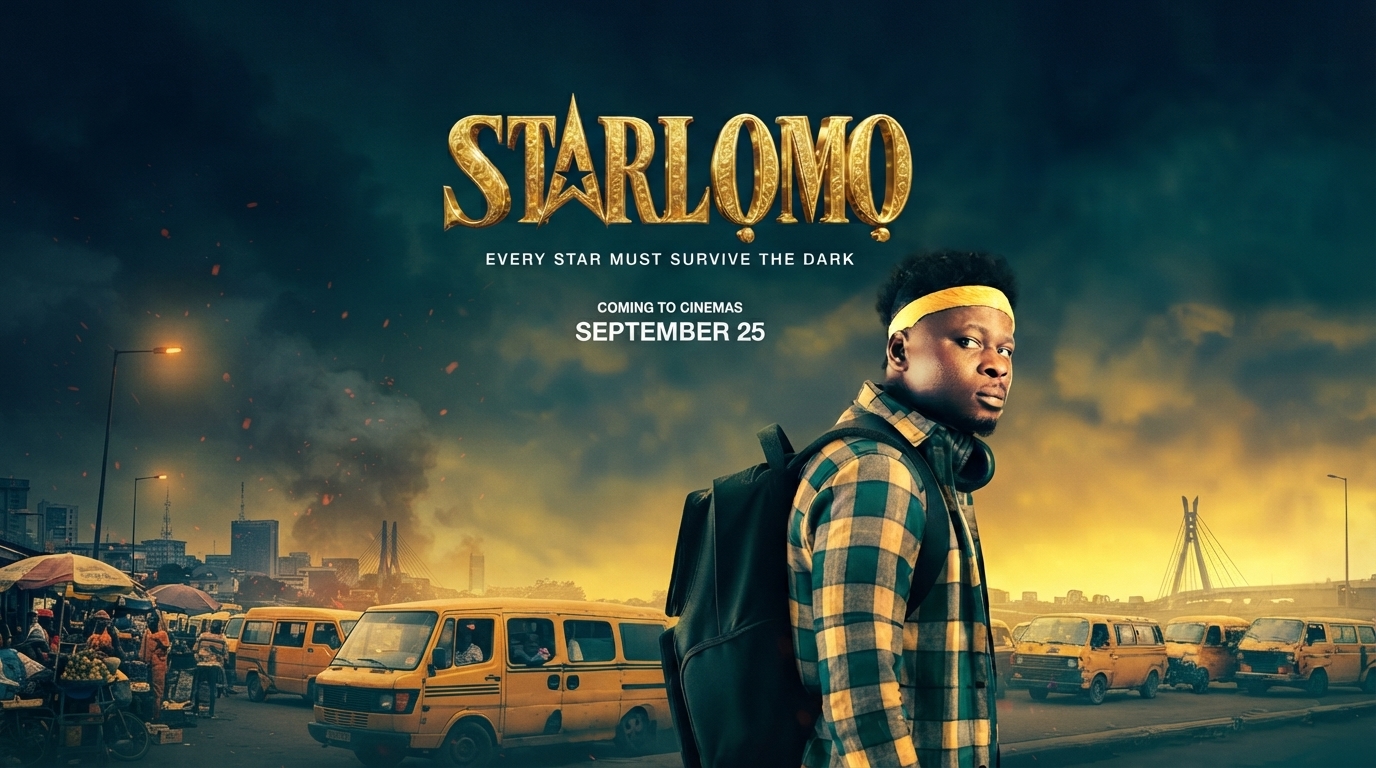
I have seen people argue that Starlomo should not be judged too harshly because this is Kamo State’s first major feature film. I understand that argument, and I respect the courage it takes to move from skit-making and online content into a full-length cinema production. But at the same time, being someone’s first movie does not mean audiences should ignore its shortcomings, especially when they have paid cinema prices to watch it. For me, Starlomo feels more like an early attempt at filmmaking that should have gone through more development before reaching the big screen. If this exact film had been released on YouTube or Netflix, I would have been much more forgiving. But as a cinema release, I expected a considerably higher standard.
Directed by Kayode Kasum and starring Akinyoola Ayoola, popularly known as Kamo State, Starlomo tells the story of Ayotide, a young man who leaves his family’s food business to pursue his dream of becoming a musician in Lagos. His journey takes him into difficult circumstances, including an exploitative taxi operation, before tragedy eventually brings him back home and forces him to confront his family’s connection to Fuji music.
The premise itself isn’t bad. In fact, there is a potentially interesting movie buried somewhere inside Starlomo. A story about ambition, family, music, loss and discovering one’s roots could have been emotionally powerful.
Unfortunately, the execution left me extremely disappointed.
A Story Without a Clear Direction
My biggest problem with Starlomo is that the movie never really felt like it knew exactly where it was going.
From the beginning to the end, I struggled to understand what the film wanted to achieve beyond simply moving its characters from one situation to another. There were several interesting ideas introduced, but they were not developed strongly enough to create a compelling story.
The family, the music, Ayotide’s ambitions, his experience in Lagos and the tragedy surrounding his parents could have been woven together into something powerful. Instead, many of these elements felt disconnected.
For a movie running for about two hours and being presented as a cinema production, I expected much more.
Kamo State’s Performance
This is where I think the difference between online content and feature filmmaking became very obvious.
Kamo State is undoubtedly talented in his own space, but carrying a two-hour dramatic movie is a completely different challenge.
Unfortunately, I did not think he was ready for the role.
His acting often felt forced, and his narration did little to improve the experience. Instead of making me more emotionally invested in Ayotide’s journey, some of the narration made the movie feel even more amateurish.
There is a natural learning curve when someone moves from skits to feature films, and I have no problem acknowledging that this is his first major attempt. But as an audience member who paid to sit in a cinema, I can only judge what was presented to me.
And what was presented did not work for me.
The Acting and Casting
Apart from Biola Adebayo and Ibrahim Chatta, I struggled to find performances that genuinely stood out.
Both actors brought a level of confidence and naturalness to their roles that I felt was missing from much of the rest of the cast.
The problem wasn’t necessarily that every actor was incapable. I also believe the director has to take some responsibility when performances feel unnatural. A good director should be able to guide actors, particularly those who are less experienced, towards believable performances.
Unfortunately, Starlomo often felt like a movie where the actors were simply saying their lines rather than genuinely living inside their characters.
My Acting Rating: 2/10
And Where Was the Comic Relief?
For a movie that had comedic moments, I found the humour extremely weak.
There was a particular moment involving KieKie where it felt like the movie was trying very hard to create comic relief. Unfortunately, the joke was simply dry.
I watched the movie in a cinema hall with about 10 people, and nobody laughed.
Of course, one cinema audience cannot determine whether a joke is objectively funny. But when a scene is clearly designed to generate laughter and the entire hall remains silent, it tells you something about how poorly that particular moment landed.
More importantly, the movie needed something to break up its long stretches of drama, because the two-hour runtime felt considerably longer than it should have.
Direction
This was probably the biggest disappointment for me.
Kayode Kasum is not a new filmmaker, which makes the lack of cohesion even more surprising.
The movie frequently felt like it was being directed scene by scene rather than as one complete story. Emotional moments didn’t have the impact they should have, certain scenes dragged, and the overall pacing made the film feel longer than its actual runtime.
I kept waiting for the story to eventually come together.
It never really did.
My Directing Rating: 1/10
Cinematography and Picture Quality
Visually, Starlomo is probably one of the less problematic aspects of the film.
The picture quality is decent and the cinematography is acceptable. However, I didn’t find much about the visual presentation that particularly impressed me or gave the movie a strong cinematic identity.
For a film made for the big screen, I expected more.
My Cinematography/Picture Quality Rating: 5/10
Was the Cinema Release the Right Decision?
This is probably the most controversial part of my review.
I understand why Kamo State wanted to take Starlomo to cinemas. It is a major achievement to move from creating online skits to producing and starring in a feature film.
But I honestly think the movie would have been better received if it had been released on a platform like YouTube or Netflix first.
Why?
Because audiences on those platforms have a different relationship with the content. People can watch from home, discover the filmmaker, give feedback and appreciate the movie as a first attempt without feeling that they have spent significant money and time on a cinema experience that doesn’t meet the expected standard.
Cinema comes with expectations.
When I buy a cinema ticket, I expect a finished product that feels ready for the big screen.
Starlomo, to me, still feels like a filmmaker’s first serious attempt that needed more work before reaching that stage.
And I don’t think saying that means we are trying to destroy Kamo State’s career. In fact, honest criticism can be more useful than simply telling someone that everything is good because it is their first movie.
Final Verdict
I really wanted to like Starlomo.
I didn’t go into the cinema expecting a masterpiece, so my disappointment isn’t because the movie failed to meet some unrealistic standard I had created in my head. I simply didn’t expect it to feel this underdeveloped.
There is a story here. There is an interesting concept here. And there is definitely potential in Kamo State as a filmmaker if he continues learning and surrounds himself with the right people.
But potential is not the same as execution.
For me, Starlomo needed a much stronger screenplay, better direction, more convincing performances and tighter editing before being released as a cinema feature.
The biggest lesson here is simple: your first movie can be a learning experience, but when you put it in cinemas, the audience is still paying to watch a finished movie.
Unfortunately, I felt like I was watching a filmmaker’s learning process rather than a fully developed cinema film.
PhiskVideos Rating
Acting: 2/10
Casting: 2/10
Story: 1/10
Directing: 1/10
Cinematography/Picture Quality: 5/10
Overall Rating: 2/10
Two hours was a lot.